


Configure DualEntry
Configure DualEntry
Configure how Expensify imports accounting data from DualEntry and exports expenses back to your accounting system.
If you haven’t connected DualEntry yet, learn how to connect to DualEntry.
Once configured, you can:
- Import categories, tags, and tax rates from DualEntry.
- Export out-of-pocket and card expenses.
- Automatically sync reports, reimbursements, and settlements.
Where to find DualEntry configuration settings
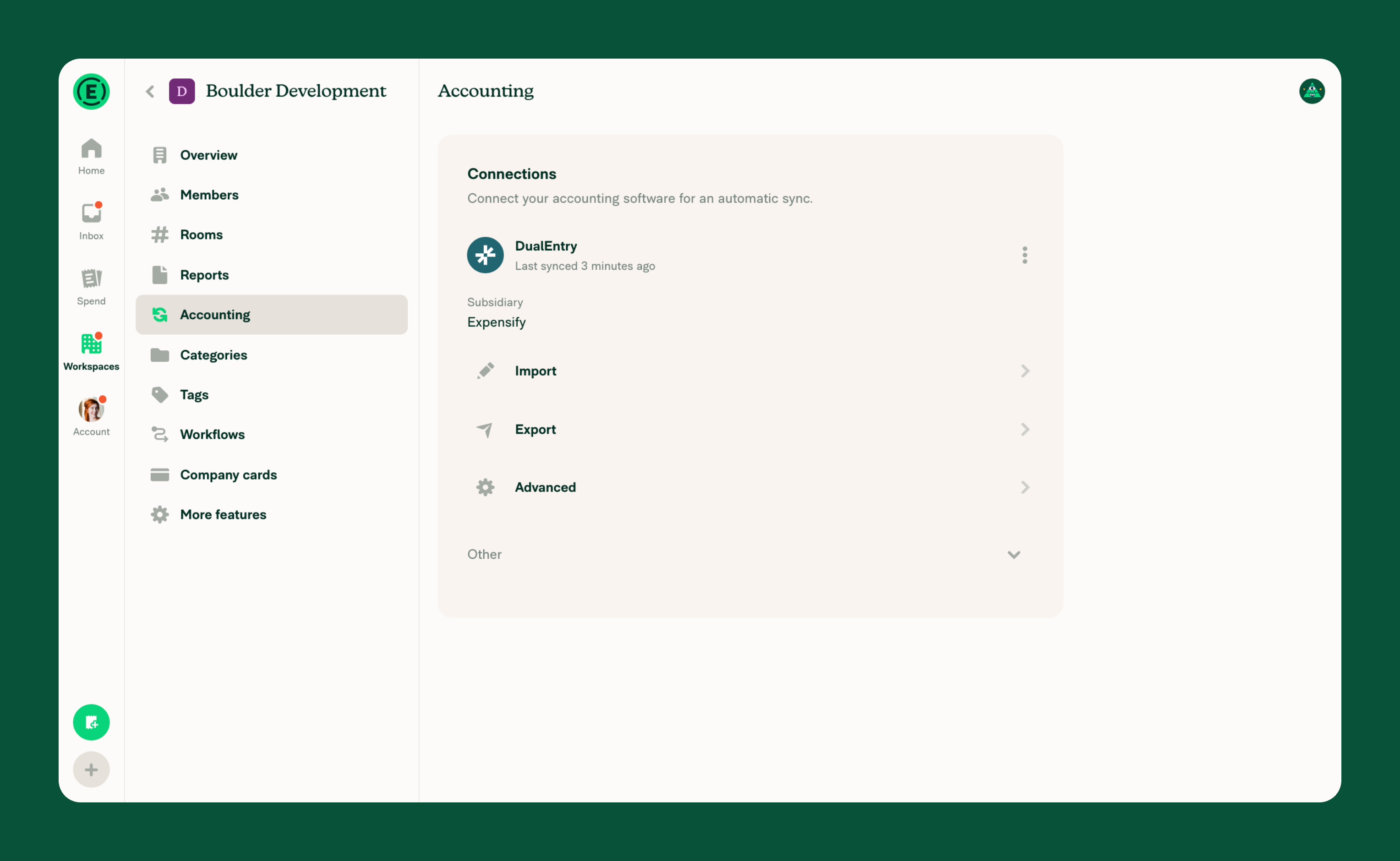
Each Workspace has its own DualEntry integration. To view or update the configuration settings:
- In the navigation tabs (on the left on web, on the bottom on mobile) go to Workspaces > [workspace name].
- Select Accounting.
- On the DualEntry connection, select Import, Export, or Advanced.
How to configure DualEntry import settings
Import settings control which accounting data is imported from DualEntry into Expensify.
On the DualEntry integration, choose Import to configure:
- Chart of accounts – Imports active expense (including cost of goods sold), current asset, and fixed asset accounts as categories. This setting is always enabled.
- Enable newly imported accounts – Choose whether newly imported accounts arrive as enabled or disabled categories. This defaults to off, so new accounts import as disabled categories.
- Classifications – Choose which DualEntry classifications to import as tags. Each available classification can be enabled independently, and all classifications are off by default.
- Tax rates – Import active VAT or GST rates from DualEntry. This option only appears when tax rates are available in DualEntry, and is off by default.
How to configure DualEntry export settings
Export settings determine how Expensify sends data to DualEntry.
On the DualEntry integration, choose Export and configure:
- Preferred exporter – Assign the Workspace Admin to automatically receive reports to export.
- Export reimbursable expenses as – Reimbursable expenses export as vendor bills.
- Vendor bill date – Choose whether exports use the date of the last expense, the export date, or the submitted date.
- Export out-of-pocket expenses as – Out-of-pocket expenses export as vendor bills.
- Export company card expenses as – Company card and Expensify Card expenses export as direct expenses.
- Default vendor for all company cards – Select the vendor used when an export can’t be matched to a vendor automatically.
- Company card account – Select the DualEntry account used for company card expenses.
- Configure exporting to multiple accounts – Configure different DualEntry accounts for individual card programs or cards. This setting is off by default.
When Configure exporting to multiple accounts is enabled:
- Card program account lets you override the workspace Company card account for individual card programs.
- Per-card account lets you override the card program account for an individual card.
An individual card uses its per-card account when one is configured. Otherwise, it uses its card program account. If the card program doesn’t have an account override, it uses the workspace Company card account.
You can also change an individual company card’s DualEntry export account from its card details.
To review or change the vendor on an individual expense before it exports, learn how to manage vendor matching for DualEntry.
How to configure DualEntry advanced settings
Advanced settings control sync frequency, reimbursement, and settlement automation.
On the DualEntry integration, choose Advanced to configure:
- Auto-sync – Automatically sync Expensify and DualEntry every day and export eligible reports automatically. Auto-sync is enabled after the first successful sync unless an admin previously changed the setting.
- Export method – Choose when reports are exported automatically. This option is only available when auto-sync is enabled and defaults to Accrual.
- Accrual exports out-of-pocket expenses after final approval.
- Cash exports out-of-pocket expenses after they are paid.
- Sync reimbursed reports – Automatically create bill payments in DualEntry when exported out-of-pocket reports are reimbursed in Expensify. This is enabled by default.
- Bill payment account – Select the DualEntry bank account used for bill payments. Expensify automatically selects an eligible bank account when possible.
- Sync Expensify Card settlements – Automatically sync Expensify Card settlement payments to DualEntry. This setting appears when Expensify Cards are enabled for the workspace.
- Expensify Card settlement account – Select the active USD bank account used for Expensify Card settlements.
- Sync Travel Invoicing settlements – Automatically sync Travel Invoicing settlement payments to DualEntry. This setting appears when Travel Invoicing is enabled.
- Travel Invoicing settlement account – Select the account used for Travel Invoicing settlements.
- Travel Invoicing payable account – Select the payable account used for Travel Invoicing settlements.
FAQ
Which DualEntry accounts import as categories?
Only active expense (including cost of goods sold), current asset, and fixed asset accounts from your DualEntry chart of accounts import as categories.
The initial chart of accounts arrives enabled. After that, Enable newly imported accounts determines whether newly imported accounts arrive as enabled or disabled categories.
Why did my report fail to export to DualEntry?
Out-of-pocket expenses export as vendor bills matched to the report submitter’s email. If no DualEntry vendor matches that email, the export fails. Make sure the report submitter exists as a vendor in DualEntry with a matching email address.
Which DualEntry account does a company card use?
By default, company card and Expensify Card expenses use the workspace Company card account.
If Configure exporting to multiple accounts is enabled, a card can instead use a card program account or a per-card account. Per-card settings take precedence over the card program account, and the card program account takes precedence over the workspace Company card account.
Do I need a bill payment or settlement account?
A bill payment account is required only when Sync reimbursed reports is enabled. A settlement account is required only when Sync Expensify Card settlements or Sync Travel Invoicing settlements is enabled.


